After the playtest, we got really good feedback but also found out some flaws. We went through the feedback and then make some changes to make the game better, especially working on wording, organizing, and restriction on voting.
Sabotage -> Interjection
From the feedback of the game “Movie Mayhem”, play testers found that the movement which is to interact other player with cards is not properly named. When a player wants to “sabotage” others, they sacrifice their own cards, but use it to enlarge other-player’s story. However, on most situation players that got “sabotaged” are actually with short length story and hardly to finish. And “sabotage” just simply enlarge they story and helps them to finish on time. However, the original meaning of “sabotage” is to interfere others movement in bad ways. Due to this, group members had a discussion and decided to change the name “sabotage” to “interjection” which can be both positive and negative meaning. With this wording, later play testers said that it makes more sense, and also helps with understanding the game.
2. A discard pile for each player
From the playtest, play testers also pointed out that while playing the game, cards that are discard are not properly organized. Player just simply throw the card onto the table and sometimes mass the game a bit especially while some players miss take what the card that previous player used into his story. This makes the game seem to be not well organized. So, we make an attempt that making a discard pile for each player so that the cards that are discard will not mass the game while it’s in progress. In later playtests, it shows a better organized game, and no player are disrupted by the discarded cards.
3. Players cannot reward themselves
There’s one more flaw about this game is player can reward themselves in the voting phase. During the playtest, players found that there’s no restriction on voting. So they all reward themselves in order to win the largest prize – “best overall”. This makes the game boring if all players all reward themselves the “best overall” prize but put no effort and passion on making their story in order to win the prize. According to this, we decided to add a restriction that player cannot reward themselves. Due to this, players are only encouraged to make good story to gain honor rather than just vote themselves, and in later playtests players make better story and are more enjoying the game.
After all, several changes make huge different. By making these changes we make the game more reasonable while interjecting other’s story, and we also make the game more organized. Players also enjoy the game more. Trying their best to win the best prize. However, even if they don’t get the “best overall” prize they will also gain they own prize to honor their effort.
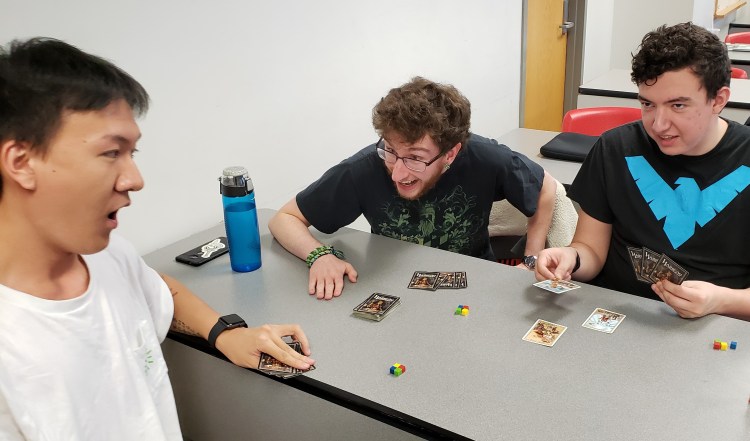
The second session of playtesting that occurred after these changes.
We are also creating a website to showcase the game once it is complete and ready to be showcased to the world. Stay tuned for more information, we can’t wait to showcase what we’ve worked on!
A landmark event for Movie Mayhem, the first non-developer playtesting session occurred last week on the 6th of December. The game was tested by a group of avid game fans in the IMGD 1000 class at WPI.
Overall, initial impression of the game was positive.
Student Ryan Harris reacted with: “Movie Mayhem is unlike any other game I’ve played in this class so far, as, rather than having lots of complex mechanics, this game has just a few simple core mechanics that build the game in such a way that the players themselves actually end up being more of a core part of the game play than the actual game itself.”
Praise continues with Geoffrey Garsson’s insight: “As someone who has pitched games before, presentations for movies and games should take 1-2 minutes at maximum to keep things short at to-the-point, and this game emulates that time commitment perfectly.”
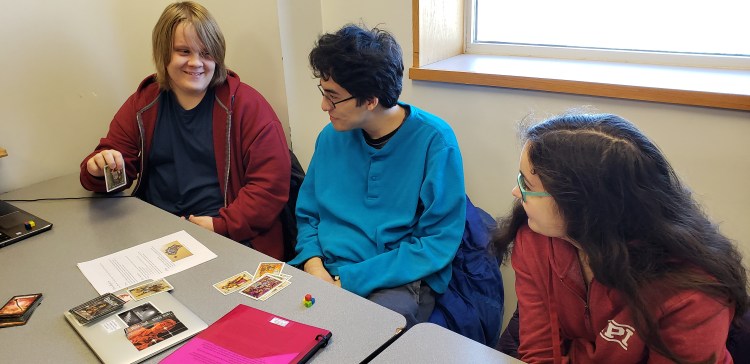
A play testing session underway with the developers of the game!
There were two major criticisms, however. First, most of the testers thought that players should not be able to award themselves blocks. This was something the team had intended; however, it was not explicitly stated in the rules. Second, they noted that it would be beneficial for each player to keep a pile of the cards they used to tell their story, so the pile could be referenced later during the awards.
There was even some positive reaction to mechanics the developers were unsure about. Designer Sean O’Connor said, “We were originally concerned the ‘sabotaging’ would be intrusive and overall bad.” The playtesting showed these intrusions to other players stories often helped to create a better overall story. The testers also pointed out that this mechanic further keeps players involved when another person is telling a story. Players are already invested in the story since they need to be in order to vote, but by allowing the player to directly affect the speaker’s story there is a whole different layer of interactivity.
And now thoughts from a designer:
“The feedback definitely gave us a lot to think about. It was largely positive with very few criticisms, so that leads to a few natural questions: is there nothing to criticize because the game is good? Possibly. Is there so much to criticize that it was easier for the testers to pretend they understood? Doesn’t seem like it. Is there not much to criticize because there’s not much there? Only more testing will tell.
“It was interesting to see one tester recommend playing multiple rounds of the game, so that everyone gets the chance to be first. This was something we had originally discussed, but ultimately eliminated due to the time constraint. I do think it’s a valid point, first does seem to have an advantage in some regards, but there may also be disadvantages to going first.
“As it stands, we are pretty proud of what we have so far and have been excited to get this feedback. We look forward to our second playtest results later this week.”
Hi folks, how’s it going? Recently, a huge change has taken place in our game, which is the change in title and settings of our game Fortune’s Outcome. As we are making a mechanic driven game based on telling stories with random cards with words, we determined our theme afterward. As the cards we are given to make Fortune Outcome have a fantasy theme, it was not a surprise of us that we came up with a similar theme for it. So that the story everyone tells can match the setting of the game. Under this theme, we wrote our lore and made our game closer to a story like Lord of The Rings, but the players get to decide their own fate by telling their life stories.
At this stage, the theme of Fortune Outcome seemed to work well with its mechanics. However, there are two existing problems with this Lord of the Rings fantasy theme. The first one is that we felt it could be a little cliché to have another medieval fantasy theme in our game as the last two games we have made already had similar themes. We wanted to make a theme that would make people curious. Also, the win condition in Fortune Outcome is to have a player’s story is to have the winner’s story being voted the most. This voting process could not fit well into our theme. Who would even vote back then?
Very soon, we discovered our third problem with our theme. Our group member Yanbo had one of his friends available for playtesting, so we invited him to play the game with us. We let him guide us through the game and we would try not to speak about the rules. However, we noticed our subject has been looking at the lore part for too long and seemed very confused. This is when we understood our fantasy theme itself is not related to our core mechanic storytelling. The theme itself does not imply what the players are going to do in this game.
Therefore, we came up with another theme of directors making movies. This theme just straightaway sounds much more intriguing and less cliché. A board game of making movies is pretty rare! Also, the voting part, in the end, will be a mini Oscar award nomination, which fits perfectly and sounds much more fun. In this way, we get all our mechanics fully covered by the theme. Besides, the players can now get the idea that they are somehow going to make stories just by looking at the title and lore. So, they will not get false expectation of what our game is going to be. Therefore, we have changed our theme to a much better one and get ourselves a pretty alliteration title: Movie Mayhem.
The theme of fantasy and myth evolved into the rush and crunch of pitching movies as a movie director.
That’s all for our recent change in title and theme. Share your feedback to our recent changes in the comment section below. See you all next time!
While picking our supplies, we kept considering the possibilities we would have available to us through them. With the hourglass, we decided having a time-based mechanic in our game would be an interesting idea and could provide a strong backbone for a party-like game; one where competition and rivalry took a backseat to laughing and having a good time.
Choosing the cards led to us developing the idea of a card game where players come up with ridiculous scenarios and stories based on the cards dealt to them. Next, we knew we needed to come up with a way for players to “win,” leading to us choosing the coins for our third item to use for “points” when a player won a round. After refining the concept a bit, we exchanged them for colored cubes on the swapping day.
We took inspiration from games like Cards Against Humanity, where players have to use two cards to conceive the funniest combination possible in order to win rounds. We also took cues from Mad Libs, where players are given a template for a story and have to fill in nouns and adjectives to create a humorous tale. Our game ends up functioning as a bit of a reverse-Mad Libs, with the player given the nouns in the form of the cards and given the task of creating the story around them.
We determined that the turns would last for the duration of one rotation of the hourglass, which was about two minutes and twenty seconds. Originally, we were unsure if the player would have one rotation to devise a story and then another rotation to tell it, but after testing, we determined this would be too long, plus allowing the player to determine how to divide their allotted time between planning and storytelling would be a strategic element.
We went through a few different configurations for distributing the cards, starting with allowing the player to see their cards from the start of the game. Upon realizing this would lead to the last-turn player having more time to formulate their story, we changed the rules so the player cannot look at their cards before their turn.
In one iteration, a designated judge placed three cards out for every player to build a story off of.
The stories begin by flipping over a card from the pile of non-dealt cards. Originally, each player used the same card, but upon realizing this would lead to very similar stories , each player now picks a new card on their turn. The round ends when every player has gone.
We went through a few iterations of the award process, before settling on the current iteration, where each player gets one of four colored cubes, representing four categories: best setting (red), best protagonist (blue), most likely to pirate online (for being good) (green), and finally, best overall (yellow). The player with the most cubes wins the round, and they’re encouraged to make a “victory speech” if they’d like, just for fun.
It took some polishing, but we designed a concept we enjoyed that felt like it had fulfilled our initial idea for a casual party game.
Before we crafted our current game, the ideas had to come from a deck of Harrow cards, blocks, coins, sand, fortune telling, and college debt.
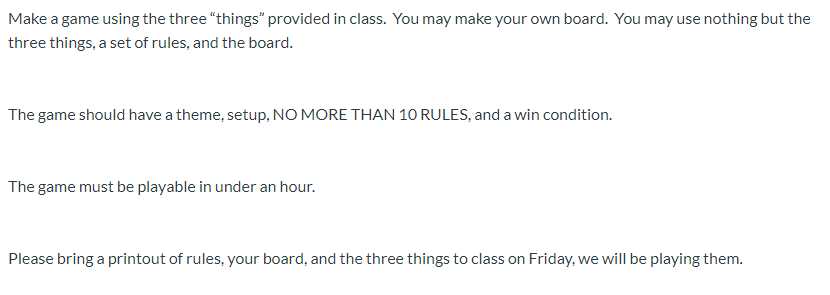
As soon as development started, we were already under specific constraints. These included only having 10 rules, using only the materials we choose, and the game needing to be under an hour in length. Along with these, a story, theme, setup, and win condition needed to be present in the rules. A board was also an optional piece that could be created.
The original restrictions placed on our game.
In the early stages of creating our game that would become Fortune’s Outcome, we tried to find a concept that would stick. Early on, the team wanted to make a game that was easy for people to learn and could be fun for everyone. However, the challenge was doing this with the given materials: a deck of Harrow cards that contained different names and images, a set of goblin coins, a set of dragon coins, and an hourglass.
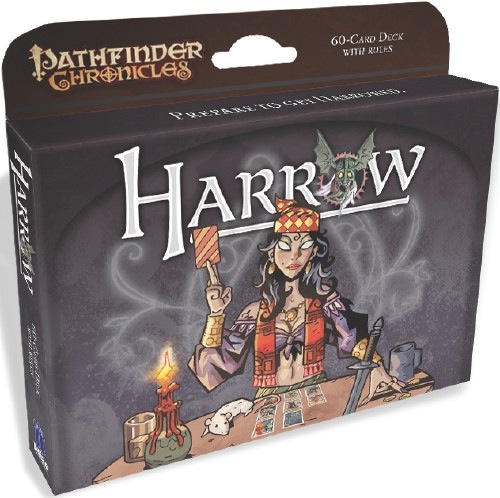
The chosen deck of Harrow cards.
We initially considered the idea of a game centered around college. Players were students that needed to get through each term while staying out of debt. Ultimately, this idea was dropped, as we had trouble coming up with ways to make a compelling game with the materials we had to choose in such a short time. Problems were also present in how we could integrate the materials thematically, since they dealt more so with fantasy and fortune telling than the more mundane setting of a school. With these factors, we went back to the drawing board.
The next idea was for a game that was to be casual and lighthearted, with less of an emphasis on beating each other and more so just having fun. A comparable feeling is when you are with a group of friends, just relaxing and talking about strange, off-the-wall subjects that ultimately lead to tons of laughs and inside jokes. The challenge was how we could evoke this feeling while still giving the game purpose and depth. With the three materials chosen, we decided to create a game focused on story telling that would take advantage of the elements of fantasy and fortune telling.
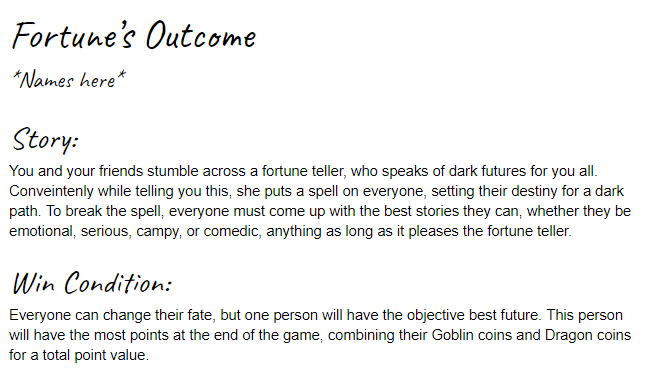
The concept of using fortune telling as the game’s theme and the use of dragon and goblin coins as points set the game in motion. The story centered around the players stumbling across a fortune teller who tells them of their dark futures, while she puts a curse on them at the same time. To dispose of the curse, the players must come up with the best stories. Everyone could get rid of the curse, but the person with the best story would have the objective best future among the group. We wanted there to be no pressure for winning, rather, everyone won by just having a good time.
The original version of the title, story and win condition.
With this new foundation, we moved on into creating the game play. What began as the idea of a story telling game would slowly evolve over the course of creating and testing the game.
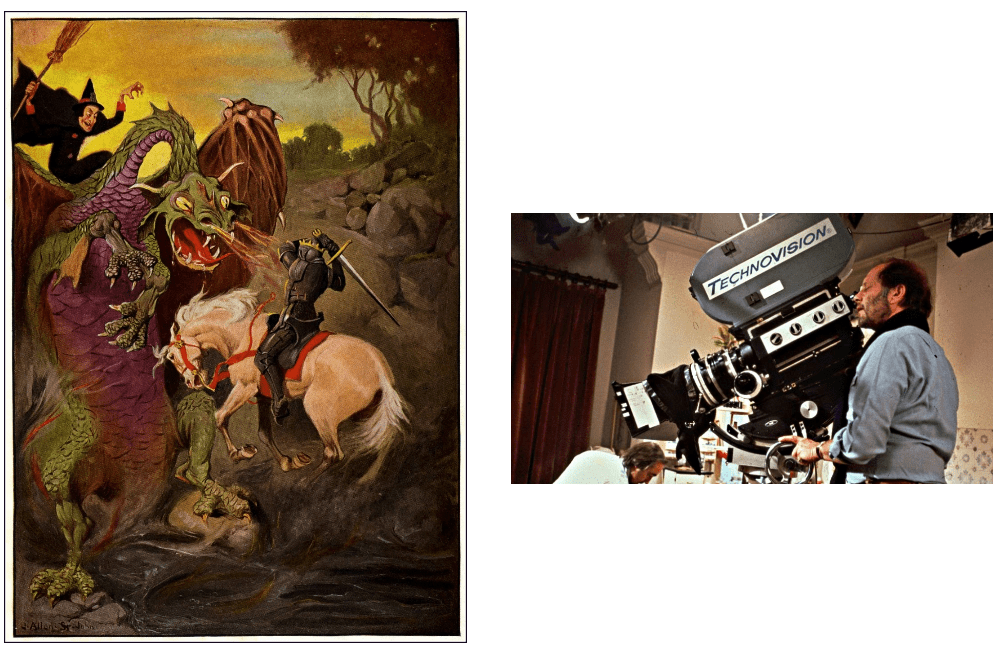

 The Bits